
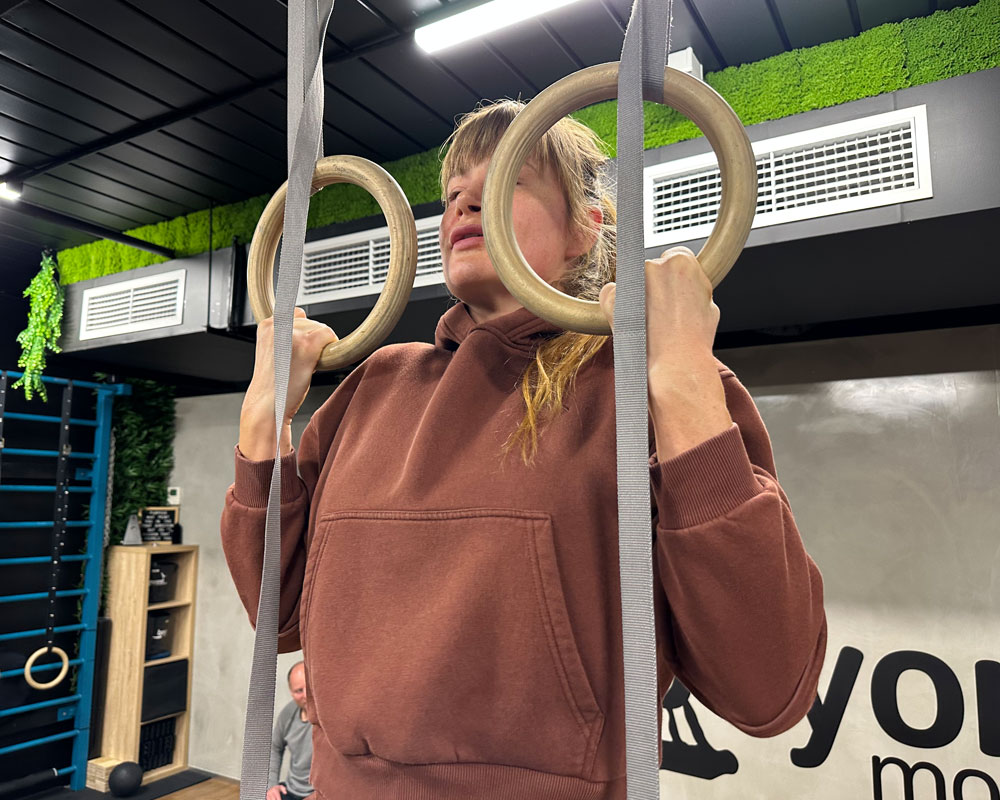
False Grip
Essential grip technique for ring muscle-ups, where the wrist sits over the rings allowing for smooth transitions.
The false grip is a fundamental technique for ring training, particularly essential for achieving a smooth muscle-up on rings. This grip positions your wrist over the rings rather than hanging below them, eliminating the need to transition your grip during the muscle-up.
Key Technique Points
Place the heel of your palm on top of the ring
Wrap your fingers around and grip firmly
Keep wrists flexed throughout the movement
Start with short holds and gradually increase duration
What it trains
Wrist flexors, finger flexors and the whole forearm, plus a large tolerance demand on the skin and soft tissue of the wrist itself. The biceps and brachialis take more load than in a normal grip because the forearm sits in a shortened position throughout.
It is less a strength quality than a tolerance one. The false grip is what lets the wrist stay above the rings through the transition of a muscle-up, so without it the muscle-up has to be muscled through with a hard pull and a fast turnover. Most people find the limiting factor is not strength but how long the wrist can bear the position, which is why it is trained with accumulated hold time rather than heavy work.
Prerequisites
- Basic ring support hold for 30+ seconds
- Dead hang for 60+ seconds
- Basic understanding of ring positioning
Common mistakes
-
Letting the wrist slip below the rings
Maintain active wrist flexion and grip pressure throughout
-
Death gripping the rings too tightly
Use just enough pressure to maintain position without exhausting forearms
-
Not building grip endurance gradually
Start with 5-10 second holds and progressively increase duration
Learn This Skill In These Classes
Related Skills
Foundation
Ring Support Hold
Coming Soon
Variation
Ring Rows with False Grip
Coming Soon
Progression
Muscle-Up
The ultimate pulling exercise that combines an explosive pull-up with a dip transition. Master this dynamic movement to showcase true upper body power.
Common questions about False Grip
How long does it take to learn False Grip?
Most people need 2-4 weeks of consistent, coached practice. That assumes you can already meet the prerequisites below — starting without them is the single biggest reason progress stalls.
What do you need before starting False Grip?
Build these first: Basic ring support hold for 30+ seconds,Dead hang for 60+ seconds,Basic understanding of ring positioning. Each one removes a specific limitation, so working on them is not a detour — it is the fastest route to the skill.
What muscles are worked in False Grip?
Wrist flexors, finger flexors and the whole forearm, plus a large tolerance demand on the skin and soft tissue of the wrist itself. The biceps and brachialis take more load than in a normal grip because the forearm sits in a shortened position throughout.
It is less a strength quality than a tolerance one. The false grip is what lets the wrist stay above the rings through the transition of a muscle-up, so without it the muscle-up has to be muscled through with a hard pull and a fast turnover. Most people find the limiting factor is not strength but how long the wrist can bear the position, which is why it is trained with accumulated hold time rather than heavy work.
What are the most common False Grip mistakes?
- Letting the wrist slip below the rings — Maintain active wrist flexion and grip pressure throughout
- Death gripping the rings too tightly — Use just enough pressure to maintain position without exhausting forearms
- Not building grip endurance gradually — Start with 5-10 second holds and progressively increase duration
Does the false grip hurt your wrists?
It is uncomfortable at first for everyone - the ring sits across the wrist crease and the skin has not adapted. That discomfort should fade over a few weeks of short, frequent holds. Sharp pain, or pain that lingers the next day, means you are holding too long too soon rather than that the grip is wrong for you.
Do you need a false grip for a muscle-up?
For a ring muscle-up, effectively yes. Without it the wrist has to rotate around the ring mid-transition, which costs time and height and turns the movement into a fast, forceful heave. On a bar you can get away without it; on rings it is the difference between a controlled muscle-up and a lucky one.
How long should you hold a false grip?
Work toward 30 seconds of a false grip hang with the wrists genuinely above the rings. Build it with several short holds in a session rather than one long one - this is a tissue tolerance adaptation, and frequency does more for it than duration.