
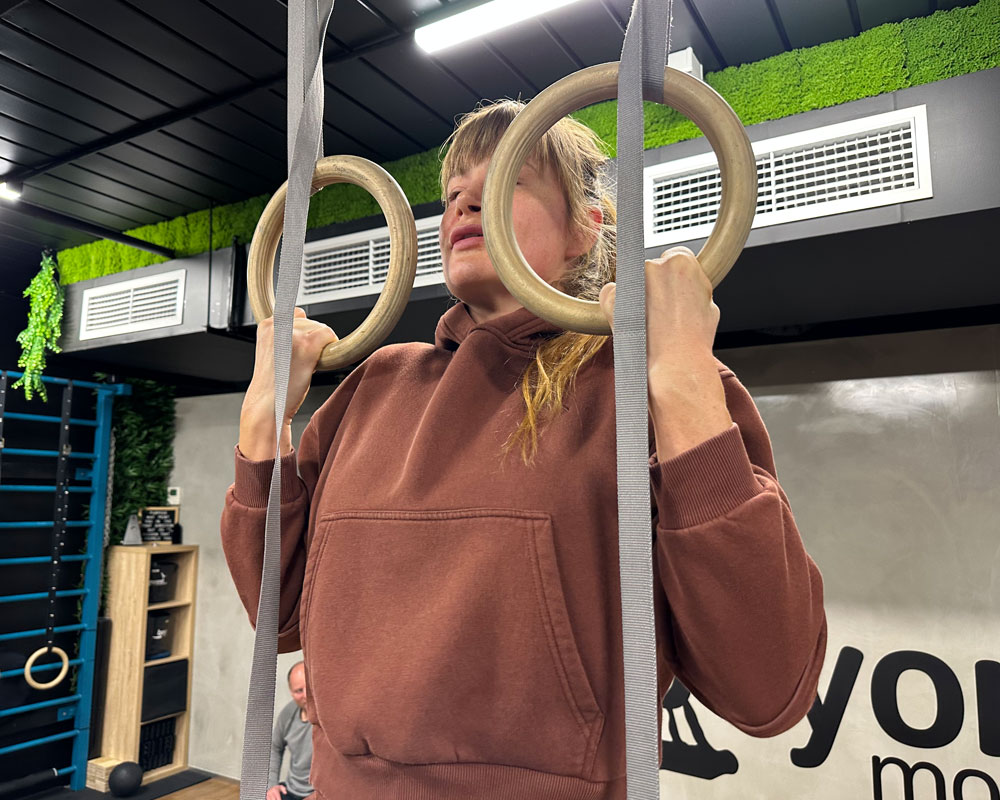
Ring Support Hold
Build stability on unstable rings. This fundamental position develops the strength and control for advanced ring work.
The ring support hold challenges the basic support position by adding the instability of freely moving rings. This fundamental position requires constant stabilization from shoulders, chest, and core while teaching the ring control essential for advanced movements. Though simple in concept, the ring support hold proves significantly more challenging than parallel bar supports.
Beyond Movement introduces ring support holds early in ring training, recognizing their foundational importance. The progression from assisted holds to extended durations with good form builds the specific stability required for ring dips, muscle-ups, and advanced positions. We emphasize proper ring turnout and shoulder positioning to maximize stability and joint safety.
Ring support hold development creates benefits extending throughout upper body training. The constant stabilization requirements build small muscles often neglected in traditional training while teaching body awareness crucial for gymnastics movements. The position also serves as an excellent diagnostic tool, revealing weaknesses in shoulder stability or core control that require attention.
What it trains
An isometric hold that loads the rotator cuff, serratus anterior and lower trapezius - the scapular stabilisers - far harder than any pressing movement does. The lats and pecs work to keep the rings pulled in, and the triceps hold the elbow locked.
It is the entry point to every other ring skill, and it is also the most honest diagnostic in the library. The shaking that everyone experiences on their first attempt is not weakness in the prime movers; it is the stabilisers being asked to do a job they have never been given. Almost every ring skill that stalls further up the progression traces back to a support hold that was never made solid.
Prerequisites
- 30+ second bar support hold
- Basic ring familiarity
- Healthy shoulders
- Understanding of shoulder positioning
Common mistakes
-
Rings too wide
Keep close to body
-
Lack of turnout
Rotate rings outward
-
Shrugged shoulders
Depress shoulder blades
-
Excessive tension
Stay strong but relaxed
-
Looking down
Maintain neutral head
Learn This Skill In These Classes
Related Skills
Foundation
Support Hold
Coming Soon
Foundation
Shoulder Conditioning
Build bulletproof shoulders with targeted strengthening exercises. Essential for injury prevention and advanced skill development.
Foundation
Ring Familiarization
Coming Soon
Progression
Ring Dips
Master dips on unstable rings for superior strength and stability. Essential for muscle-up development and upper body power.
Progression
Ring Muscle-Up
Coming Soon
Progression
Iron Cross
The ultimate ring strength position. This iconic skill demonstrates exceptional straight-arm pushing power.
Common questions about Ring Support Hold
How long does it take to learn Ring Support Hold?
Most people need 2-4 weeks of consistent, coached practice. That assumes you can already meet the prerequisites below — starting without them is the single biggest reason progress stalls.
What do you need before starting Ring Support Hold?
Build these first: 30+ second bar support hold,Basic ring familiarity,Healthy shoulders,Understanding of shoulder positioning. Each one removes a specific limitation, so working on them is not a detour — it is the fastest route to the skill.
What muscles are worked in Ring Support Hold?
An isometric hold that loads the rotator cuff, serratus anterior and lower trapezius - the scapular stabilisers - far harder than any pressing movement does. The lats and pecs work to keep the rings pulled in, and the triceps hold the elbow locked.
It is the entry point to every other ring skill, and it is also the most honest diagnostic in the library. The shaking that everyone experiences on their first attempt is not weakness in the prime movers; it is the stabilisers being asked to do a job they have never been given. Almost every ring skill that stalls further up the progression traces back to a support hold that was never made solid.
What are the most common Ring Support Hold mistakes?
- Rings too wide — Keep close to body
- Lack of turnout — Rotate rings outward
- Shrugged shoulders — Depress shoulder blades
- Excessive tension — Stay strong but relaxed
- Looking down — Maintain neutral head
Why do the rings shake so much in a support hold?
Because your stabilising muscles have not yet learned to coordinate against a point that can move in any direction. It is normal, it happens to strong people, and it settles within two to four weeks of consistent practice. Shorter, more frequent holds fix it faster than one long grim attempt.
How long should you hold a ring support?
Sixty seconds with locked elbows and the rings turned out is the standard to aim for before progressing to dips or muscle-up work. Thirty seconds is a reasonable first milestone. Quality matters more than duration - a shaky 45 seconds is worth less than a still 20.
What does turning the rings out actually do?
Rotating the rings so your palms face forward at the top externally rotates the shoulder, which puts the joint in its strongest and safest position and switches the lats on properly. If you can hold a support but cannot turn the rings out, the hold is not finished yet.