
Front Lever
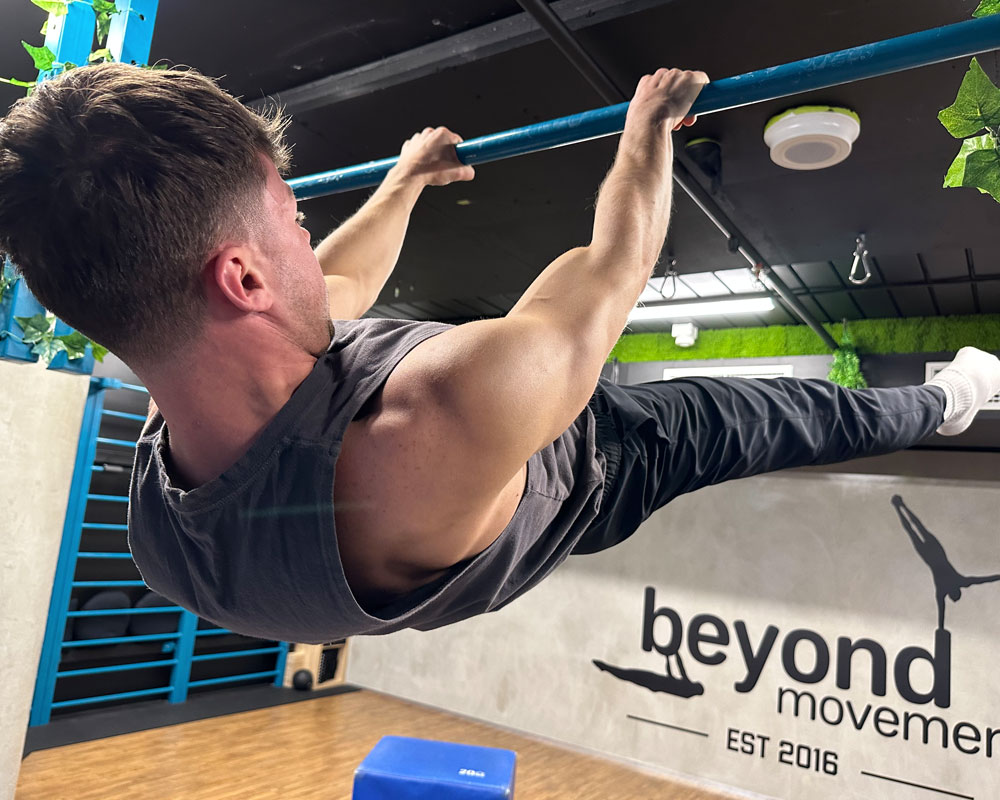
Achieve a horizontal body position while hanging from a bar or rings. This impressive skill builds incredible pulling strength and core stability.
The front lever showcases the pinnacle of pulling strength—maintaining a completely horizontal body position while hanging from a bar or rings with straight arms. This skill demands exceptional lat strength, core stability, and the ability to generate tremendous tension throughout the entire body. The visual impact of a well-executed front lever makes it one of the most sought-after skills in calisthenics.
Beyond Movement's approach to front lever training emphasizes progressive overload through systematic holds and dynamic variations. The journey typically begins with tucked positions and advances through advanced tuck, straddle, and finally the full front lever. Each progression demands patience, as the strength requirements increase exponentially with each advancement in leverage.
The front lever develops a unique type of pulling strength that surpasses traditional exercises in its demands on the latissimus dorsi and core. Athletes find the strength and body control developed through front lever training transfers remarkably to climbing, swimming, and martial arts movements requiring powerful pulling mechanics.
How to do it
- 1 Confirm the prerequisites: around 8 to 10 strict pull-ups and a solid hollow body hold Straight-arm strength takes time - rushing this hurts elbows
- 2 Hang from the bar and pull the shoulder blades down and back Scapular pull-ups are the real starting point
- 3 Tuck your knees to your chest and lift until your back is horizontal Arms stay straight throughout
- 4 Hold the tuck for 10 to 15 seconds, then progress to advanced tuck by opening the hips Keep the lower back flat against an imaginary wall
- 5 Move to a single-leg lever, extending one leg while the other stays tucked Swap legs each set to stay even
- 6 Progress to straddle, then full, as each position holds for 10 seconds clean If the hips drop, regress a stage
What it trains
The front lever trains straight-arm pulling strength through the lats and teres major, with the core working hard to stop the hips sagging and the lower back extending.
The straight arm is the whole difficulty. With a bent elbow your biceps share the load; locked out, the lats and shoulders take it through a long lever, which is why the strength does not transfer directly from pull-ups no matter how many you can do.
It also demands real anterior core control. Most failed front levers are not a lat problem but a pelvis problem - the hips drop, the back arches, and the lever gets longer and harder. Training the hollow body position pays off here more than extra pulling volume.
Prerequisites
- 15+ strict pull-ups with control
- Strong core (60+ second hollow hold)
- Skin the cat mobility and strength
- Understanding of full-body tension
- Healthy shoulders and elbows
Common mistakes
-
Piked hips
Maintain straight line from shoulders to feet
-
Bent arms
Build specific straight-arm pulling strength
-
Progressing by momentum
Focus on static holds over dynamic work
-
Neglecting antagonist training
Balance with pushing exercises
-
Ignoring connective tissue adaptation
Allow adequate recovery
Related Skills
Foundation
Pull-Ups
The king of upper body exercises. Build the pulling strength essential for muscle-ups, levers, and climbing movements.
Foundation
Hollow Body Hold
The fundamental core position for all gymnastics movements. Master this to unlock handstands, levers, and advanced skills.
Foundation
Dragon Flag
Coming Soon
Progression
Front Lever Pulls
Add dynamic movement to your front lever. This advanced exercise builds incredible pulling strength and control.
Progression
Front Lever to Muscle-Up
Coming Soon
Progression
One Arm Front Lever
Coming Soon
Common questions about Front Lever
How long does it take to learn Front Lever?
Most people need 1-2 years of consistent, coached practice. That assumes you can already meet the prerequisites below — starting without them is the single biggest reason progress stalls.
What do you need before starting Front Lever?
Build these first: 15+ strict pull-ups with control,Strong core (60+ second hollow hold),Skin the cat mobility and strength,Understanding of full-body tension,Healthy shoulders and elbows. Each one removes a specific limitation, so working on them is not a detour — it is the fastest route to the skill.
What muscles are worked in Front Lever?
The front lever trains straight-arm pulling strength through the lats and teres major, with the core working hard to stop the hips sagging and the lower back extending.
The straight arm is the whole difficulty. With a bent elbow your biceps share the load; locked out, the lats and shoulders take it through a long lever, which is why the strength does not transfer directly from pull-ups no matter how many you can do.
It also demands real anterior core control. Most failed front levers are not a lat problem but a pelvis problem - the hips drop, the back arches, and the lever gets longer and harder. Training the hollow body position pays off here more than extra pulling volume.
What are the most common Front Lever mistakes?
- Piked hips — Maintain straight line from shoulders to feet
- Bent arms — Build specific straight-arm pulling strength
- Progressing by momentum — Focus on static holds over dynamic work
- Neglecting antagonist training — Balance with pushing exercises
- Ignoring connective tissue adaptation — Allow adequate recovery