
Candlestick
Build core control with this rolling movement. Essential preparation for more advanced core exercises and gymnastics skills.
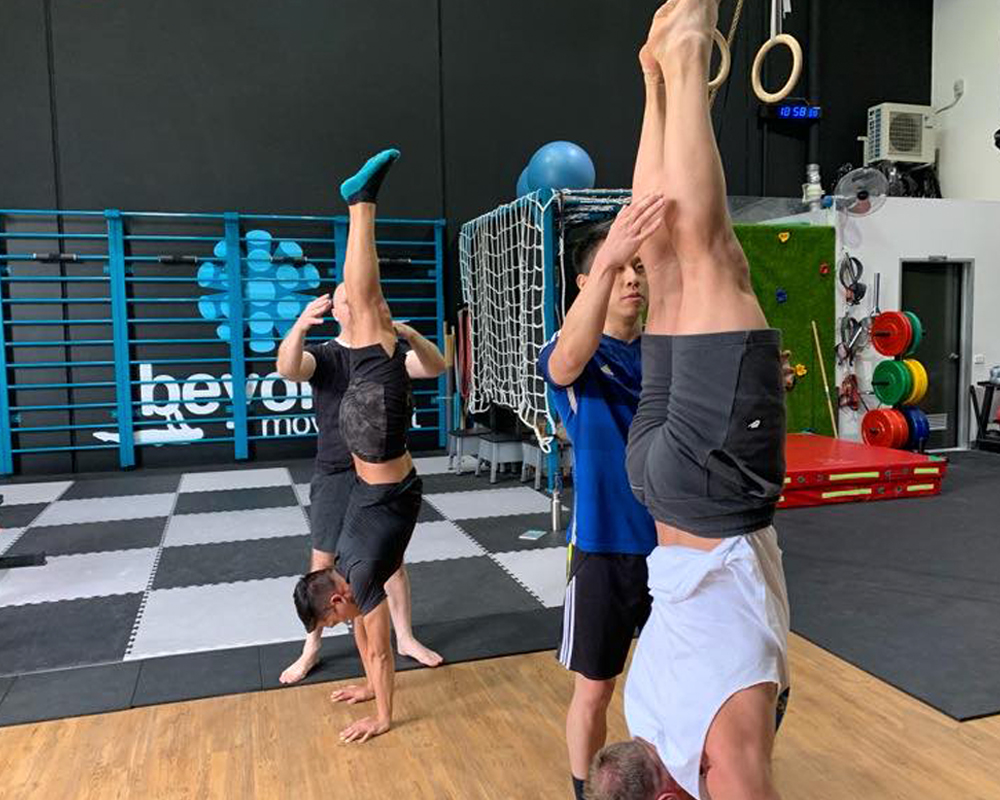
The candlestick involves rolling backward to bring legs into the air stacking directly on top hips and shoulders, then returning to laying position with control. This fundamental movement pattern teaches spinal articulation, core control, and the momentum management essential for dynamic exercises. Beyond its role as an exercise, the candlestick serves as preparation for more advanced movements like backward rolls and core exercises.
At Beyond Movement, we use candlesticks to teach controlled spinal movement and build the specific strength for exercises like dragon flags and leg raises. The progression from assisted rolls to smooth stand-ups creates achievable milestones while developing comprehensive core control. We emphasise smooth, segmental movement rather than momentum-based flopping, ensuring quality development.
Candlestick training develops unique movement capabilities valuable across disciplines. The spinal articulation improves movement quality and body awareness, while the core strength transfers to all athletic activities. Martial artists find the rolling patterns directly applicable to their practice, while the exercise serves as excellent preparation for more challenging core movements. The skill also builds confidence with inverted positions.
How to do it
- 1 Sit on the floor with knees bent and arms reaching forward Start on a mat until the roll is smooth
- 2 Roll back along your spine, one vertebra at a time Control it - do not throw yourself backwards
- 3 As your shoulders take the weight, extend the legs toward the ceiling Weight on the upper back and shoulders, never the neck
- 4 Hold briefly with hips stacked over shoulders Squeeze the glutes to stay straight
- 5 Reverse the roll, tucking the knees and returning to sitting Aim to arrive without using your hands
What it trains
The candlestick trains segmental spinal control - the ability to move your spine one section at a time rather than as a rigid block - along with core compression and shoulder stability in an inverted position.
It is a genuine foundation skill. The rolling pattern underpins safe falling, the inverted hold introduces being upside down without the wrist load of a handstand, and the compression carries directly into L-sits and press handstands.
The common limiter is a stiff thoracic spine. If your upper back does not flex smoothly the roll becomes a series of thumps, which is uncomfortable and teaches nothing. Thoracic mobility work usually improves the candlestick faster than practising the roll itself.
Prerequisites
- Basic core strength
- Spinal mobility
- No neck issues
- Understanding of rolling mechanics
Common mistakes
-
Using pure momentum
Control the movement
-
Stiff spine
Roll segmentally
-
Neck strain
Support with hands initially
-
Incomplete range
Full overhead position
-
Holding breath
Breathe throughout
Learn This Skill In These Classes
Related Skills
Foundation
Hollow Body Hold
The fundamental core position for all gymnastics movements. Master this to unlock handstands, levers, and advanced skills.
Foundation
Thoracic Mobility
Unlock your upper back for better posture and movement. Essential for overhead work and spinal health.
Variation
V-Sit
The advanced evolution of the L-sit, requiring exceptional hip compression and core strength. This skill showcases true abdominal power and flexibility.
Progression
Dragon Flag
Coming Soon
Progression
Backward Roll
Coming Soon
Progression
Candlestick to Stand
Coming Soon
Common questions about Candlestick
How long does it take to learn Candlestick?
Most people need 2-3 weeks of consistent, coached practice. That assumes you can already meet the prerequisites below — starting without them is the single biggest reason progress stalls.
What do you need before starting Candlestick?
Build these first: Basic core strength,Spinal mobility,No neck issues,Understanding of rolling mechanics. Each one removes a specific limitation, so working on them is not a detour — it is the fastest route to the skill.
What muscles are worked in Candlestick?
The candlestick trains segmental spinal control - the ability to move your spine one section at a time rather than as a rigid block - along with core compression and shoulder stability in an inverted position.
It is a genuine foundation skill. The rolling pattern underpins safe falling, the inverted hold introduces being upside down without the wrist load of a handstand, and the compression carries directly into L-sits and press handstands.
The common limiter is a stiff thoracic spine. If your upper back does not flex smoothly the roll becomes a series of thumps, which is uncomfortable and teaches nothing. Thoracic mobility work usually improves the candlestick faster than practising the roll itself.
What are the most common Candlestick mistakes?
- Using pure momentum — Control the movement
- Stiff spine — Roll segmentally
- Neck strain — Support with hands initially
- Incomplete range — Full overhead position
- Holding breath — Breathe throughout