
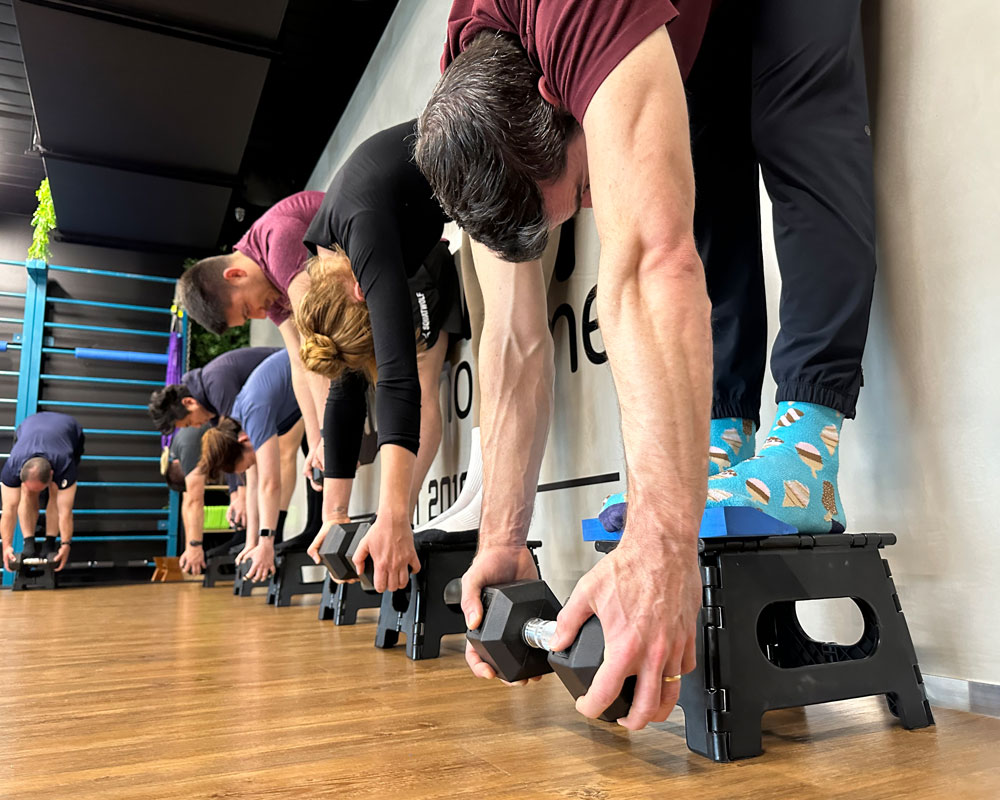
Calf Raises
Strengthen your calves for better jumping, running, and ankle stability. Often neglected but crucial for lower leg health.
Calf raises involve rising onto the toes through plantar flexion, strengthening the gastrocnemius and soleus muscles of the lower leg. This fundamental exercise addresses muscles crucial for walking, running, jumping, and balance yet often neglected in training programs. Proper calf development enhances athletic performance while preventing common lower leg injuries.
Beyond Movement incorporates calf raises throughout programming, recognizing their importance for complete lower body development. We progress from bilateral raises to single-leg variations, adding range of motion through elevated surfaces and resistance through external loading. The emphasis on full range of motion and controlled tempo ensures comprehensive development rather than partial pump work.
Strong calves contribute significantly to athletic performance and injury prevention. Runners experience improved push-off power and reduced Achilles stress, while athletes in jumping sports gain explosive power. The exercise also improves balance and ankle stability, valuable for older adults preventing falls. Regular calf training addresses the weakness and restrictions common in modern populations.
Prerequisites
- Ability to stand on one foot
- Basic balance
- No acute calf injuries
- Understanding of full range
Common mistakes
-
Partial range
Full stretch to peak contraction
-
Using momentum
Control both phases
-
Ignoring single leg
Progress to unilateral
-
Speed over quality
Emphasize time under tension
-
Neglecting soleus
Include bent-knee variations
Related Skills
Foundation
Single-Leg Balance
Develop proprioception and stability through balance training. Essential for injury prevention and athletic performance.
Foundation
Calf Stretch
Coming Soon
Variation
Ankle Mobility
Improve ankle flexibility for better squatting, jumping, and injury prevention. Often overlooked but crucial for movement quality.
Progression
Box Jumps
Develop explosive power with this plyometric exercise. Build jumping ability while learning safe landing mechanics.
Progression
Single Leg Calf Raises
Coming Soon
Progression
Weighted Calf Raises
Coming Soon
Common questions about Calf Raises
How long does it take to learn Calf Raises?
Most people need 2-4 weeks of consistent, coached practice. That assumes you can already meet the prerequisites below — starting without them is the single biggest reason progress stalls.
What do you need before starting Calf Raises?
Build these first: Ability to stand on one foot,Basic balance,No acute calf injuries,Understanding of full range. Each one removes a specific limitation, so working on them is not a detour — it is the fastest route to the skill.
What are the most common Calf Raises mistakes?
- Partial range — Full stretch to peak contraction
- Using momentum — Control both phases
- Ignoring single leg — Progress to unilateral
- Speed over quality — Emphasize time under tension
- Neglecting soleus — Include bent-knee variations