
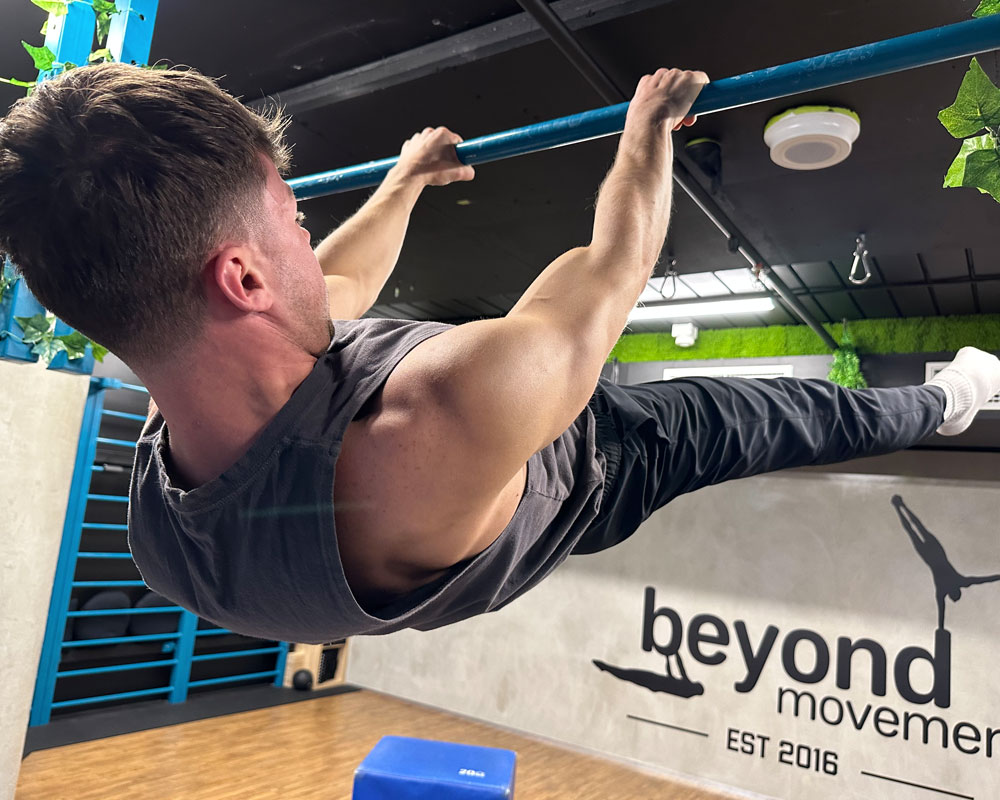
Human Flag
The iconic sideways hold that defies gravity. This skill combines pressing and pulling strength with exceptional lateral core stability.
The human flag captures imagination like few other calisthenics skills—holding the body horizontal while gripping a vertical pole, creating the illusion of a human flag waving in the wind. This skill demands a unique combination of pushing strength from the bottom arm, pulling strength from the top arm, and exceptional lateral core stability to maintain the position. The visual impact makes it a favourite for demonstrations and social media.
Beyond Movement's approach to flag training emphasizes proper hand positioning and progressive holds that build the specific strength patterns required. The skill's unique demands on the lateral chain—particularly the obliques and lateral deltoids—create strength benefits unavailable through traditional training. The progression from tucked flags through straddle to full flag requires patience and consistent practice.
The human flag develops functional strength patterns valuable for any activity requiring lateral stability or unilateral strength. Athletes in rotational sports find particular benefit from the anti-rotation strength developed, while the skill itself serves as an excellent benchmark for overall calisthenics development.
How to do it
- 1 Build the base first: strong overhead pressing and solid side plank strength This is an advanced skill - the prerequisites are not optional
- 2 Set your grip on a vertical pole, top hand pulling, bottom hand pushing Roughly shoulder-width apart on the pole
- 3 Start with a support hold, feet on the ground, learning the push-pull tension The bottom arm presses hard - this is the surprise for most people
- 4 Progress to a tucked flag, knees pulled to chest, body clear of the ground Squeeze everything and hold briefly
- 5 Extend to a single-leg flag, then straddle Widening the legs shortens the lever and makes it easier
- 6 Work toward the full flag with legs together and body horizontal Expect this to take many months
What it trains
The human flag is a whole-body isometric. The top arm pulls through the lat while the bottom arm presses through the shoulder and chest, and the obliques hold the body horizontal against gravity.
The bottom arm is the part almost everyone underestimates. It is doing a one-arm overhead press against your entire bodyweight, which is why people with strong lats but limited pressing strength stall at the tuck.
It also demands serious lateral core strength - the side of the trunk holding your legs up against a long lever. Side plank progressions and heavy carries build this more directly than any amount of flag attempts.
Prerequisites
- Strong side plank (90+ seconds)
- One-arm hang ability
- Solid handstand practice
- Exceptional core strength
- Understanding of push-pull coordination
Common mistakes
-
Poor hand spacing
Find optimal grip width for leverage
-
Neglecting bottom arm push
Develop equal push and pull
-
Piked hips
Maintain straight line throughout body
-
Holding breath
Learn to breathe under extreme tension
-
Impatient progression
Build through systematic holds
Related Skills
Foundation
One Arm Hang
Coming Soon
Foundation
handstand
Coming Soon
Foundation
Oblique Conditioning
Coming Soon
Progression
Human Flag Pulls
Coming Soon
Progression
Human Flag Push Ups
Coming Soon
Progression
Switch Flags
Coming Soon
Common questions about Human Flag
How long does it take to learn Human Flag?
Most people need 2-3 years of consistent, coached practice. That assumes you can already meet the prerequisites below — starting without them is the single biggest reason progress stalls.
What do you need before starting Human Flag?
Build these first: Strong side plank (90+ seconds),One-arm hang ability,Solid handstand practice,Exceptional core strength,Understanding of push-pull coordination. Each one removes a specific limitation, so working on them is not a detour — it is the fastest route to the skill.
What muscles are worked in Human Flag?
The human flag is a whole-body isometric. The top arm pulls through the lat while the bottom arm presses through the shoulder and chest, and the obliques hold the body horizontal against gravity.
The bottom arm is the part almost everyone underestimates. It is doing a one-arm overhead press against your entire bodyweight, which is why people with strong lats but limited pressing strength stall at the tuck.
It also demands serious lateral core strength - the side of the trunk holding your legs up against a long lever. Side plank progressions and heavy carries build this more directly than any amount of flag attempts.
What are the most common Human Flag mistakes?
- Poor hand spacing — Find optimal grip width for leverage
- Neglecting bottom arm push — Develop equal push and pull
- Piked hips — Maintain straight line throughout body
- Holding breath — Learn to breathe under extreme tension
- Impatient progression — Build through systematic holds