
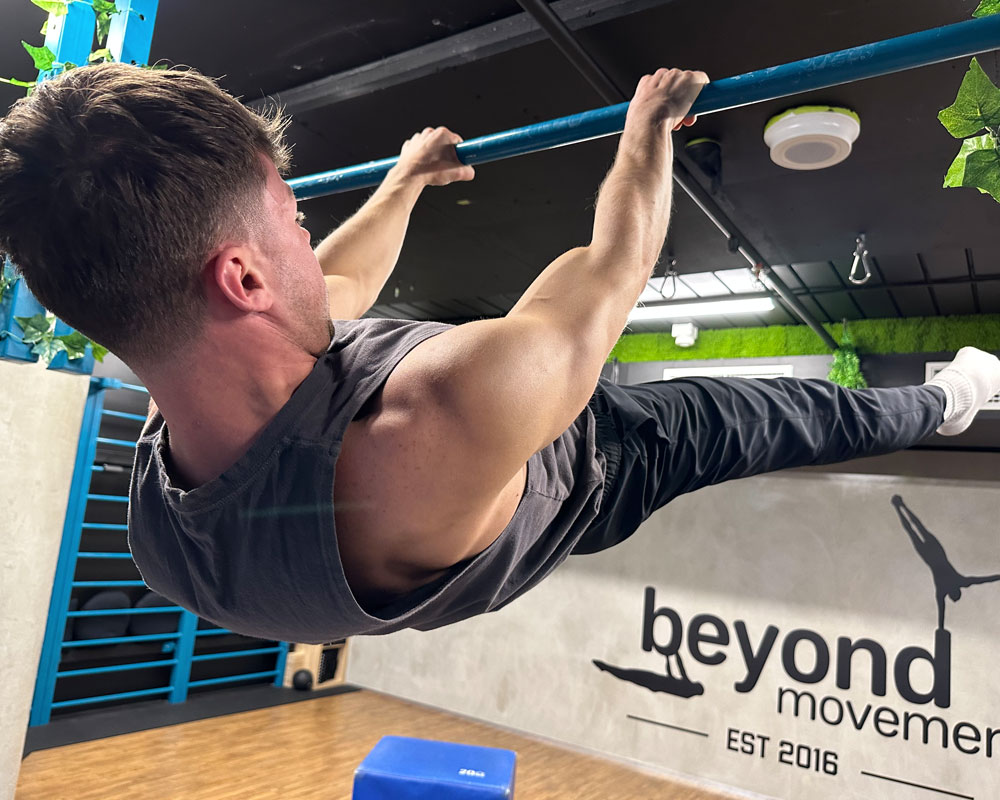
L-Sit
Build exceptional core strength with this fundamental hold. The L-sit develops compression strength essential for advanced gymnastics movements.
The L-sit stands as a fundamental building block in gymnastics strength training, creating an "L" shape with your body while supporting your weight on your hands. This deceptively simple position challenges core strength, hip flexor endurance, and shoulder stability simultaneously, making it one of the most efficient exercises for developing functional strength.
At Beyond Movement, we use the L-sit as a gateway skill that teaches crucial concepts like active compression, shoulder depression, and sustained muscle tension. The skill can be performed on the floor (most challenging), parallettes, or rings, with each variation offering unique benefits. The progression from bent-knee holds to the full L-sit creates achievable milestones that maintain motivation while building strength.
Beyond its role as a strength builder, the L-sit develops the specific neuromuscular patterns required for advanced skills like V-sits, press handstands, and planche progressions. For office workers, it directly addresses the hip flexor weakness and poor posture endemic to desk-based lifestyles.
Prerequisites
- 30-second hollow body hold with good form
- 30-second support hold on chosen apparatus
- Basic hamstring flexibility for straight legs
- Understanding of scapular depression
- Core endurance for sustained holds
Common mistakes
-
Rounded back position
Maintain proud chest throughout hold
-
Bent knees compensating
Address hamstring flexibility separately
-
Shoulders rolling forward
Keep shoulders stacked over or behind hands
-
Holding breath
Develop controlled breathing during holds
-
Gripping too hard
Learn to relax unnecessary tension
Related Skills
Foundation
Hollow Body Hold
The fundamental core position for all gymnastics movements. Master this to unlock handstands, levers, and advanced skills.
Foundation
Support Hold
Coming Soon
Foundation
Hamstring Flexibility
Develop flexible and strong hamstrings for better movement. Essential for forward folds, kicks, and injury prevention.
Progression
V-Sit
The advanced evolution of the L-sit, requiring exceptional hip compression and core strength. This skill showcases true abdominal power and flexibility.
Progression
L-Sit to Handstand
Coming Soon
Progression
L-Sit Pull-Ups
Combine pulling and core compression in this challenging variation. Build exceptional strength while improving body control.
Progression
Straddle L-Sit
Coming Soon
Common questions about L-Sit
How long does it take to learn L-Sit?
Most people need 2-3 months of consistent, coached practice. That assumes you can already meet the prerequisites below — starting without them is the single biggest reason progress stalls.
What do you need before starting L-Sit?
Build these first: 30-second hollow body hold with good form,30-second support hold on chosen apparatus,Basic hamstring flexibility for straight legs,Understanding of scapular depression,Core endurance for sustained holds. Each one removes a specific limitation, so working on them is not a detour — it is the fastest route to the skill.
What are the most common L-Sit mistakes?
- Rounded back position — Maintain proud chest throughout hold
- Bent knees compensating — Address hamstring flexibility separately
- Shoulders rolling forward — Keep shoulders stacked over or behind hands
- Holding breath — Develop controlled breathing during holds
- Gripping too hard — Learn to relax unnecessary tension