
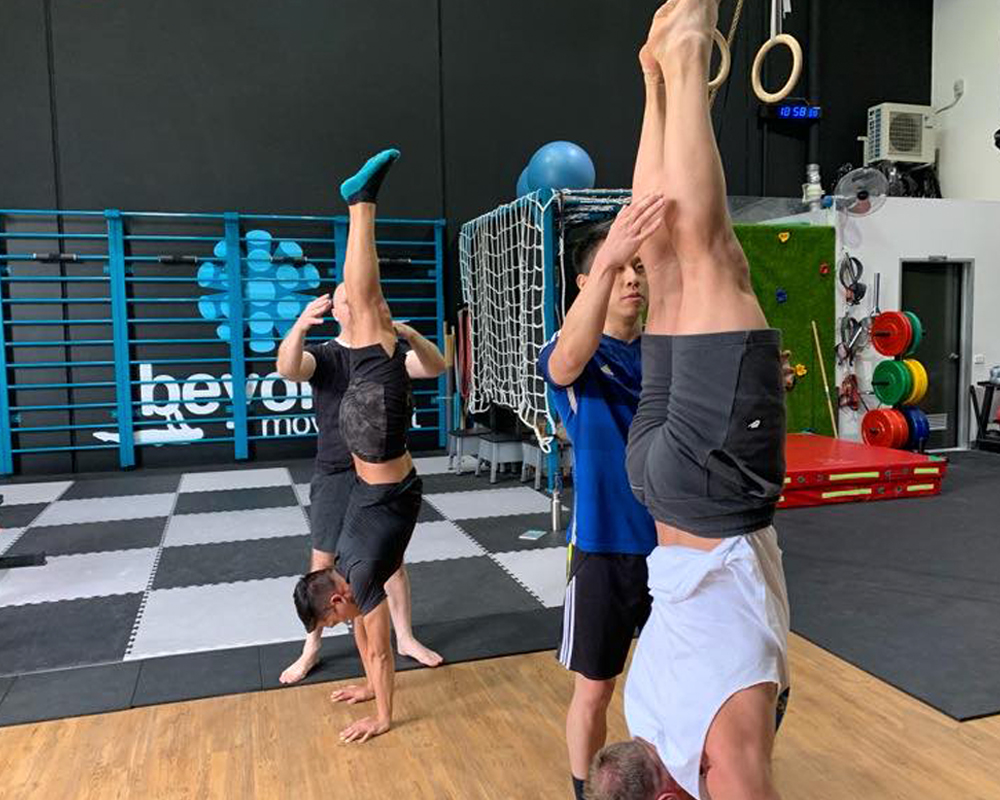
Ring Handstand
Master the ultimate balance challenge—handstand on unstable rings. This elite skill demands years of dedicated practice.
The ring handstand elevates the standard handstand by adding the extreme instability of rings, creating one of gymnastics' most challenging static positions. This skill demands not only perfect handstand technique but also the strength and control to stabilize through constantly moving supports. Achievement of a solid ring handstand represents elite-level hand balancing ability.
At Beyond Movement, we approach ring handstand training only with students who demonstrate exceptional handstand consistency and ring strength. The progression spans years, beginning with supported holds and gradually reducing assistance. We emphasize the importance of foundational strength in both handstands and ring work before attempting combination, as premature attempts risk injury and frustration.
Ring handstand mastery creates adaptations extending beyond the achievement itself. The constant micro-adjustments required develop proprioception and control surpassing floor handstands, while the strength demands ensure continued challenge for even elite practitioners. The skill serves as a lifetime goal that maintains training motivation while developing attributes transferable to all movement practices.
What it trains
Shoulder and scapular stability under full bodyweight in an overhead position, with the rotator cuff, serratus anterior and lower trapezius working continuously against two points that can move independently. The triceps hold the elbows locked and the core keeps the line.
On the floor, a handstand can be balanced through the fingers. On rings there is nothing to press against, so balance has to come from the shoulder itself - which is why it exposes any handstand built on a compensating line rather than a stacked one. It is one of the few skills in gymnastic strength training that stays challenging indefinitely.
Prerequisites
- 2+ minute floor handstand
- Strong ring support work
- Years of handstand practice
- Exceptional shoulder stability
- Elite-level dedication
Common mistakes
-
Rushing progression
Accept years of development
-
Neglecting basics
Maintain floor work
-
Poor ring setup
Proper height crucial
-
Gripping too hard
Stay relatively relaxed
-
Training when fatigued
Requires fresh nervous system
Learn This Skill In These Classes
Related Skills
Foundation
Freestanding Handstand
Master the art of balancing on your hands without wall support. This foundational inversion builds incredible shoulder strength, core stability, and full-body awareness.
Foundation
Ring Support
Coming Soon
Foundation
Ring Strength
Coming Soon
Foundation
Elite Balance
Coming Soon
Progression
Ring Handstand Variations
Coming Soon
Progression
Ring Handstand Press
Coming Soon
Progression
Professional Performance
Coming Soon
Common questions about Ring Handstand
How long does it take to learn Ring Handstand?
Most people need 3-5 years of consistent, coached practice. That assumes you can already meet the prerequisites below — starting without them is the single biggest reason progress stalls.
What do you need before starting Ring Handstand?
Build these first: 2+ minute floor handstand,Strong ring support work,Years of handstand practice,Exceptional shoulder stability,Elite-level dedication. Each one removes a specific limitation, so working on them is not a detour — it is the fastest route to the skill.
What muscles are worked in Ring Handstand?
Shoulder and scapular stability under full bodyweight in an overhead position, with the rotator cuff, serratus anterior and lower trapezius working continuously against two points that can move independently. The triceps hold the elbows locked and the core keeps the line.
On the floor, a handstand can be balanced through the fingers. On rings there is nothing to press against, so balance has to come from the shoulder itself - which is why it exposes any handstand built on a compensating line rather than a stacked one. It is one of the few skills in gymnastic strength training that stays challenging indefinitely.
What are the most common Ring Handstand mistakes?
- Rushing progression — Accept years of development
- Neglecting basics — Maintain floor work
- Poor ring setup — Proper height crucial
- Gripping too hard — Stay relatively relaxed
- Training when fatigued — Requires fresh nervous system
How much harder is a ring handstand than a floor handstand?
It is a different skill rather than a harder version of the same one. On the floor you correct balance through your fingers; on rings that option does not exist, so every correction has to come from the shoulder. Expect a solid two-minute floor handstand to translate to a few shaky seconds on rings at first.
What should you master before attempting a ring handstand?
A stacked, consistent floor handstand held for two minutes, a sixty-second ring support with the rings turned out, and comfortable ring dips. Attempting it before the support hold is solid is the most common reason people find it impossible rather than merely hard.
Is a ring handstand safe to train?
Yes, when it is trained in a rig with the rings set low and a coach present. The risk is not the hold itself but the exit - knowing how to bail sideways or roll out is part of the skill, and it is taught before the handstand is attempted rather than after.