
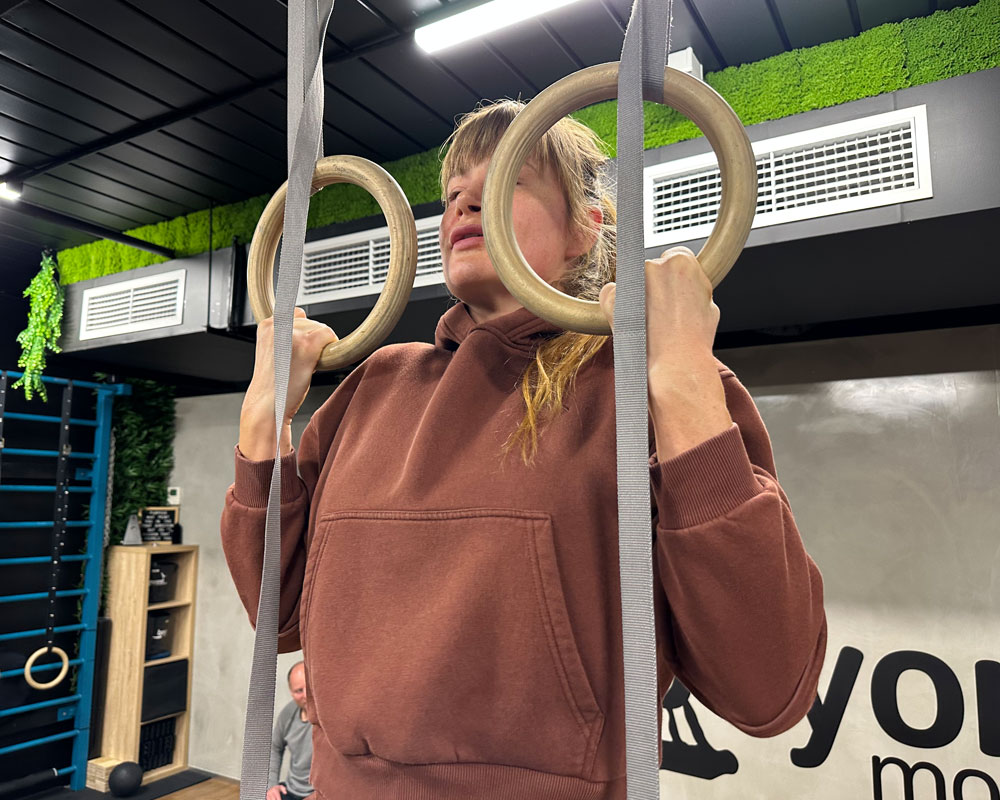
German Hang Pull
Pulling out of a german hang back to a normal hang using straight arms alone. It is the strength half of the position, and the bridge from holding shoulder extension to producing force in it.
A german hang teaches the shoulder to tolerate full extension. The german hang pull teaches it to work there. From the bottom position you pull with straight arms, driving the rings back toward your hips, and rotate yourself forward to a normal hang without bending at the elbow.
That straight-arm constraint is the whole exercise. Bending the elbows turns it into a much easier movement powered by the biceps, which is comfortable and trains almost none of what makes the drill valuable. Straight arms force the lats and teres major to produce force at a length they are rarely loaded at, which is the same quality the back lever and front lever demand.
We build it with the feet available on the floor first, taking some load out of the pull, then reducing that assistance over weeks. Progress is slow by nature - straight-arm strength develops more slowly than bent-arm strength because the connective tissue is doing more of the work - and trying to accelerate it is how biceps tendons get irritated.
What it trains
Straight-arm pulling strength through the lats, teres major and posterior deltoid, loaded at the lengthened end of their range. The biceps tendon and elbow take significant straight-arm stress, and the core resists the body folding as the pull begins.
Straight-arm strength is a distinct quality from the bent-arm strength most training develops, and it is the limiting factor in almost every advanced ring skill. Front lever, back lever, planche and iron cross all depend on it. The german hang pull is one of the few drills that trains it from a genuinely disadvantaged position, which is why it transfers so widely.
Prerequisites
- Comfortable german hang hold, 30+ seconds
- Controlled skin the cat
- Ring support hold, 60 seconds
Common mistakes
-
Bending the elbows to complete the pull
Reduce the range or keep more weight through the feet - never trade straight arms for range
-
Adding volume to force progress
Straight-arm work is tissue-limited; frequency beats intensity and rushing irritates the biceps tendon
-
Shrugging the shoulders at the start of the pull
Initiate by driving the rings toward the hips with the lats, not by lifting the shoulders
-
Losing the body line mid-pull
Stay braced through the core so the hips travel with the torso rather than folding
Learn This Skill In These Classes
Common questions about German Hang Pull
How long does it take to learn German Hang Pull?
Most people need 8-12 weeks of consistent, coached practice. That assumes you can already meet the prerequisites below — starting without them is the single biggest reason progress stalls.
What do you need before starting German Hang Pull?
Build these first: Comfortable german hang hold, 30+ seconds,Controlled skin the cat,Ring support hold, 60 seconds. Each one removes a specific limitation, so working on them is not a detour — it is the fastest route to the skill.
What muscles are worked in German Hang Pull?
Straight-arm pulling strength through the lats, teres major and posterior deltoid, loaded at the lengthened end of their range. The biceps tendon and elbow take significant straight-arm stress, and the core resists the body folding as the pull begins.
Straight-arm strength is a distinct quality from the bent-arm strength most training develops, and it is the limiting factor in almost every advanced ring skill. Front lever, back lever, planche and iron cross all depend on it. The german hang pull is one of the few drills that trains it from a genuinely disadvantaged position, which is why it transfers so widely.
What are the most common German Hang Pull mistakes?
- Bending the elbows to complete the pull — Reduce the range or keep more weight through the feet - never trade straight arms for range
- Adding volume to force progress — Straight-arm work is tissue-limited; frequency beats intensity and rushing irritates the biceps tendon
- Shrugging the shoulders at the start of the pull — Initiate by driving the rings toward the hips with the lats, not by lifting the shoulders
- Losing the body line mid-pull — Stay braced through the core so the hips travel with the torso rather than folding
Why do my arms have to stay straight?
Because bending them hands the work to the biceps and removes almost all of the training effect. The point is straight-arm pulling strength through the lats at a lengthened position, which is the quality that limits back lever, front lever and planche. A bent-arm version is a different, much easier exercise.
German hang pull or back lever first?
German hang pull first. It builds the straight-arm strength a back lever needs from a position where you can assist yourself with the floor and bail instantly. Going straight to back lever without it usually means holding a position you cannot control, which is where elbow and shoulder problems start.
Why is my progress so slow on this?
Straight-arm strength develops more slowly than bent-arm strength because connective tissue does more of the work and tissue adapts over months rather than weeks. Eight to twelve weeks to a first unassisted pull is normal. Adding volume to speed it up is the most reliable way to irritate a biceps tendon.