
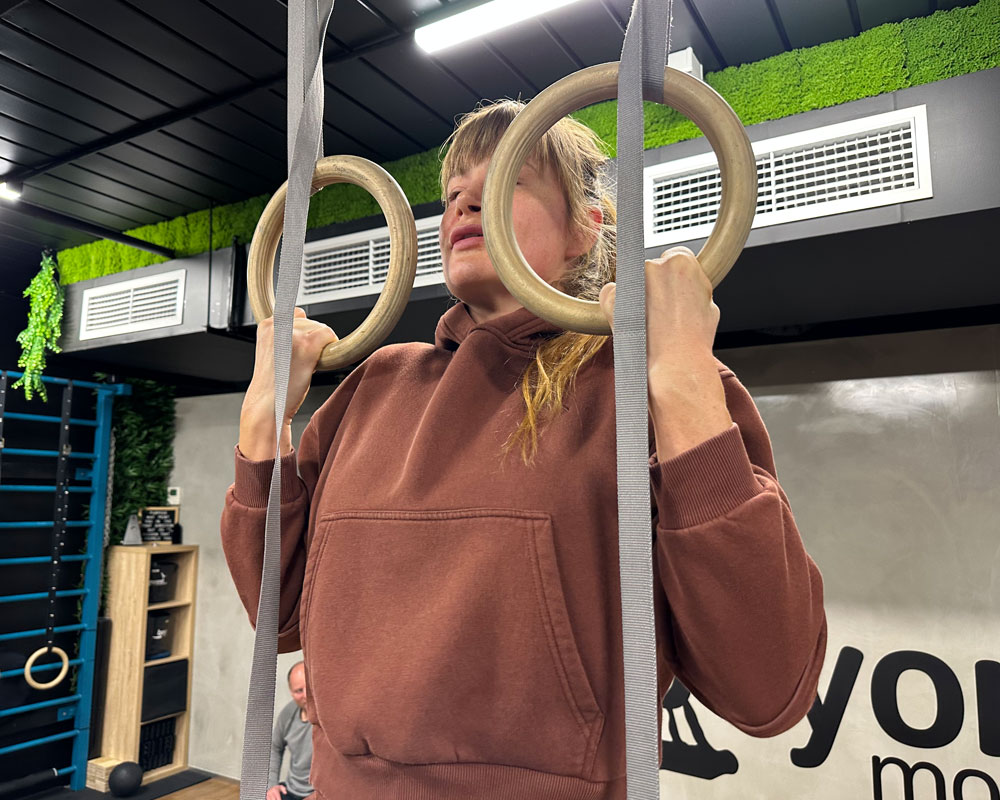
Ring Rows
Build powerful pulling strength with this fundamental ring exercise. Ring rows develop the back, biceps, and grip while teaching proper shoulder mechanics for advanced pulling movements.
Ring rows are the gateway to mastering pulling movements on gymnastics rings. This horizontal pulling exercise involves suspending your body beneath the rings and pulling your chest up to meet them, creating the perfect progression toward pull-ups and muscle-ups. The adjustable difficulty—simply by changing your body angle—makes ring rows accessible to beginners while remaining challenging for advanced practitioners seeking perfect form and control.
At Beyond Movement, ring rows form the foundation of our pulling strength curriculum. The instability of the rings demands not just raw strength but also shoulder stabilization, core engagement, and grip endurance. We teach students to view ring rows not as a simple exercise, but as a skill requiring precise technique: maintaining a rigid plank position, initiating the pull from the lats, and achieving full range of motion with the rings touching the chest.
The beauty of ring rows lies in their scalability and transferability. By adjusting foot position, you can precisely match the exercise to your current strength level, ensuring consistent progress without plateau. The movement patterns developed through ring rows directly transfer to pull-ups, muscle-ups, front levers, and even climbing movements. For those dealing with shoulder issues, ring rows offer a joint-friendly alternative to fixed-bar exercises, as the rings allow natural rotation throughout the movement.
What it trains
A horizontal pull through the lats, rhomboids, mid and lower trapezius, rear deltoids and biceps, with the whole posterior chain holding a rigid line from heel to head. The grip and forearms work throughout.
Its real value is as the counterweight to pressing. Most people arrive with far more push than pull, and that imbalance is what shows up years later as shoulder pain. Ring rows are also the most honestly scalable pull in the library - walking your feet forward or back changes the load continuously, so the same setup serves a complete beginner and someone training front lever.
Prerequisites
- Basic plank hold for 30 seconds
- Ability to hang from rings for 10+ seconds
- Understanding of scapular retraction
- Core awareness and engagement
Common mistakes
-
Sagging hips during pull
Maintain rigid plank position throughout entire movement
-
Partial range of motion
Pull until rings touch chest, fully extend arms at bottom
-
Flared elbows
Keep elbows at 45 degrees to protect shoulders
-
Using momentum
Control both concentric and eccentric phases
-
Incorrect ring height
Set rings at hip height for standard progression
Learn This Skill In These Classes
Related Skills
Foundation
Dead Hang
Build grip strength and shoulder health with this fundamental hanging exercise. The foundation for all pulling movements.
Foundation
Plank
Master the fundamental core stability position. This essential exercise builds the foundation for all movement training.
Variation
Ring Dips
Master dips on unstable rings for superior strength and stability. Essential for muscle-up development and upper body power.
Progression
Pull-Ups
The king of upper body exercises. Build the pulling strength essential for muscle-ups, levers, and climbing movements.
Progression
Muscle-Up
The ultimate pulling exercise that combines an explosive pull-up with a dip transition. Master this dynamic movement to showcase true upper body power.
Progression
Front Lever
Achieve a horizontal body position while hanging from a bar or rings. This impressive skill builds incredible pulling strength and core stability.
Common questions about Ring Rows
How long does it take to learn Ring Rows?
Most people need 2-4 weeks of consistent, coached practice. That assumes you can already meet the prerequisites below — starting without them is the single biggest reason progress stalls.
What do you need before starting Ring Rows?
Build these first: Basic plank hold for 30 seconds,Ability to hang from rings for 10+ seconds,Understanding of scapular retraction,Core awareness and engagement. Each one removes a specific limitation, so working on them is not a detour — it is the fastest route to the skill.
What muscles are worked in Ring Rows?
A horizontal pull through the lats, rhomboids, mid and lower trapezius, rear deltoids and biceps, with the whole posterior chain holding a rigid line from heel to head. The grip and forearms work throughout.
Its real value is as the counterweight to pressing. Most people arrive with far more push than pull, and that imbalance is what shows up years later as shoulder pain. Ring rows are also the most honestly scalable pull in the library - walking your feet forward or back changes the load continuously, so the same setup serves a complete beginner and someone training front lever.
What are the most common Ring Rows mistakes?
- Sagging hips during pull — Maintain rigid plank position throughout entire movement
- Partial range of motion — Pull until rings touch chest, fully extend arms at bottom
- Flared elbows — Keep elbows at 45 degrees to protect shoulders
- Using momentum — Control both concentric and eccentric phases
- Incorrect ring height — Set rings at hip height for standard progression
Are ring rows good for beginners?
They are the best pulling exercise for a beginner, because difficulty is set by body angle rather than by whether you can lift your own weight. Standing more upright makes them easy enough for anyone; walking the feet forward toward horizontal makes them genuinely hard. Nobody is too weak to start.
Will ring rows help me get my first pull-up?
Directly. They build the same lats, rhomboids and biceps a pull-up demands, but at a load you can actually control for reps. Working up to 10 to 12 rows with your body close to horizontal puts most people within reach of a first pull-up, particularly alongside dead hangs.
Ring rows or inverted rows on a bar?
Rings, if you have the choice. The bar locks your hands in a fixed position and prevents the forearm rotating as you pull, which is what irritates elbows and shoulders in higher volumes. Rings let the joint find its own path, and add a stabilisation demand the bar cannot.