
Back Lever Pull-Ups
Raising and lowering the body while holding a back lever line, driven by the lats with straight arms. An advanced lever strength progression for people who already own a solid static back lever.
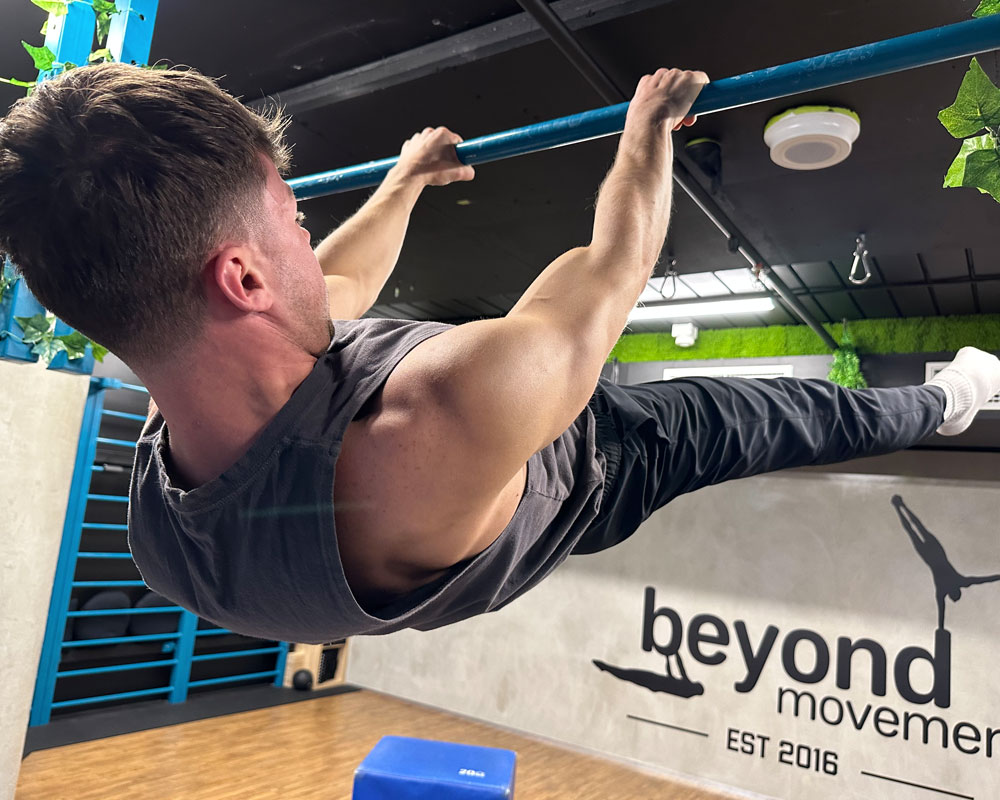
A back lever pull-up moves the body up and down while the horizontal back lever line is maintained, with the work done by the lats and shoulders through straight arms rather than by bending at the elbow. It turns a static hold into a strength exercise, and it is one of the harder ways to load straight-arm pulling.
It only makes sense once the static position is genuinely solid. A back lever held for 10 to 15 seconds with a straight line and locked elbows is the entry point; attempting the dynamic version before that means moving through a position you cannot yet control, which is where shoulder and elbow problems start.
We build it in tucked and advanced-tuck variations first, shortening the lever so the range can be trained without the full load. Progress is measured in small increases of range and in how clean the line stays, not in repetitions. Like all straight-arm work it is limited by connective tissue, so frequency and patience beat volume every time.
What it trains
Straight-arm pulling strength through the lats, teres major and posterior deltoid, loaded dynamically rather than isometrically. The biceps tendon and elbow take considerable straight-arm stress, and the whole posterior chain plus core works to hold the horizontal line while the body moves.
The distinction from a static back lever matters. Holding a position builds strength at one joint angle; moving through it builds strength across a range, which is what carries over to skills like the front lever pull and the German hang pull. It is a small population of exercises that load the lats straight-armed through range, and this is one of the most demanding of them.
Prerequisites
- Static back lever, 10-15 seconds with straight arms
- Comfortable german hang and german hang pull
- Ring support hold, 60 seconds
Common mistakes
-
Bending the elbows to complete the range
Tuck the legs to shorten the lever instead - never trade straight arms for range
-
Attempting it before the static hold is solid
Own a 10-15 second back lever with a straight line first
-
Letting the hips sag at the bottom
Brace the glutes and core so the line stays flat through the whole range
-
Chasing repetitions
Progress by range and line quality - this is tissue-limited work, not a rep scheme
Common questions about Back Lever Pull-Ups
How long does it take to learn Back Lever Pull-Ups?
Most people need 6-12 months of consistent, coached practice. That assumes you can already meet the prerequisites below — starting without them is the single biggest reason progress stalls.
What do you need before starting Back Lever Pull-Ups?
Build these first: Static back lever, 10-15 seconds with straight arms,Comfortable german hang and german hang pull,Ring support hold, 60 seconds. Each one removes a specific limitation, so working on them is not a detour — it is the fastest route to the skill.
What muscles are worked in Back Lever Pull-Ups?
Straight-arm pulling strength through the lats, teres major and posterior deltoid, loaded dynamically rather than isometrically. The biceps tendon and elbow take considerable straight-arm stress, and the whole posterior chain plus core works to hold the horizontal line while the body moves.
The distinction from a static back lever matters. Holding a position builds strength at one joint angle; moving through it builds strength across a range, which is what carries over to skills like the front lever pull and the German hang pull. It is a small population of exercises that load the lats straight-armed through range, and this is one of the most demanding of them.
What are the most common Back Lever Pull-Ups mistakes?
- Bending the elbows to complete the range — Tuck the legs to shorten the lever instead - never trade straight arms for range
- Attempting it before the static hold is solid — Own a 10-15 second back lever with a straight line first
- Letting the hips sag at the bottom — Brace the glutes and core so the line stays flat through the whole range
- Chasing repetitions — Progress by range and line quality - this is tissue-limited work, not a rep scheme
What do you need before trying back lever pull-ups?
A static back lever held 10 to 15 seconds with locked elbows and a genuinely straight line, plus comfortable german hang work. If the static hold sags or the elbows bend, the dynamic version will move you through a position you cannot control, and that is where the injuries happen.
Do your arms stay straight in a back lever pull-up?
Yes. Bending the elbows converts it into a much easier bent-arm exercise and removes the training effect entirely. If you cannot complete range with straight arms, tuck the legs to shorten the lever rather than trading away the straight-arm position.
How long does it take to get back lever pull-ups?
Six to twelve months for someone who already holds a solid back lever, and considerably longer from scratch. The limit is connective tissue adaptation at the elbow and shoulder, which happens over months regardless of how hard you train. Adding volume to speed it up reliably irritates the biceps tendon instead.